What is an Art?
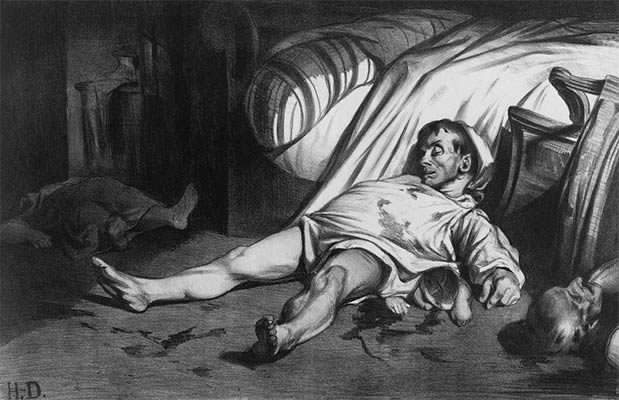
Example of Realism
Art is a diverse range of human activities in creating visual, auditory or performing artifacts (artworks), expressing the author's imaginative or technical skill, intended to be appreciated for their beauty or emotional power. In their most general form these activities include the production of works of art, the criticism of art, the study of the history of art, and the aesthetic dissemination of art.
The oldest documented forms of art are visual arts, which include creation of images or objects in fields including painting, sculpture, printmaking, photography, and other visual media. Architecture is often included as one of the visual arts; however, like the decorative arts, or advertising, it involves the creation of objects where the practical considerations of use are essential—in a way that they usually are not in a painting, for example. Music, theatre, film, dance, and other performing arts, as well as literature and other media such as interactive media, are included in a broader definition of art or the arts. Until the 17th century, art referred to any skill or mastery and was not differentiated from crafts or sciences. In modern usage after the 17th century, where aesthetic considerations are paramount, the fine arts are separated and distinguished from acquired skills in general, such as the decorative or applied arts.
Art may be characterized in terms of mimesis (its representation of reality), expression, communication of emotion, or other qualities. During the Romantic period, art came to be seen as "a special faculty of the human mind to be classified with religion and science". Though the definition of what constitutes art is disputed and has changed over time, general descriptions mention an idea of imaginative or technical skill stemming from human agency and creation.
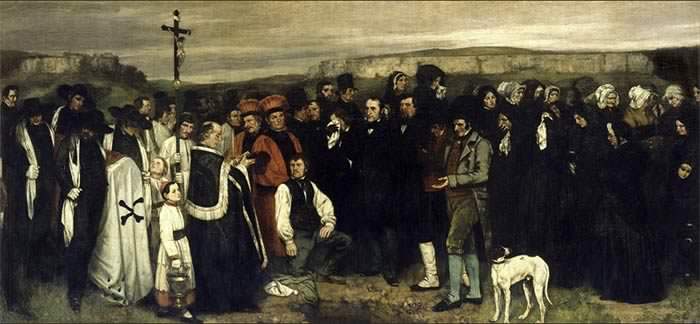
Example of Realism 2
The nature of art, and related concepts such as creativity and interpretation, are explored in a branch of philosophy known as aesthetics.
Sculptures, cave paintings, rock paintings and petroglyphs from the Upper Paleolithic dating to roughly 40,000 years ago have been found, but the precise meaning of such art is often disputed because so little is known about the cultures that produced them. The oldest art objects in the world—a series of tiny, drilled snail shells about 75,000 years old—were discovered in a South African cave. Containers that may have been used to hold paints have been found dating as far back as 100,000 years. Etched shells by Homo erectus from 430,000 and 540,000 years ago were discovered in 2014.
Many great traditions in art have a foundation in the art of one of the great ancient civilizations: Ancient Egypt, Mesopotamia, Persia, India, China, Ancient Greece, Rome, as well as Inca, Maya, and Olmec. Each of these centers of early civilization developed a unique and characteristic style in its art. Because of the size and duration of these civilizations, more of their art works have survived and more of their influence has been transmitted to other cultures and later times. Some also have provided the first records of how artists worked. For example, this period of Greek art saw a veneration of the human physical form and the development of equivalent skills to show musculature, poise, beauty, and anatomically correct proportions.
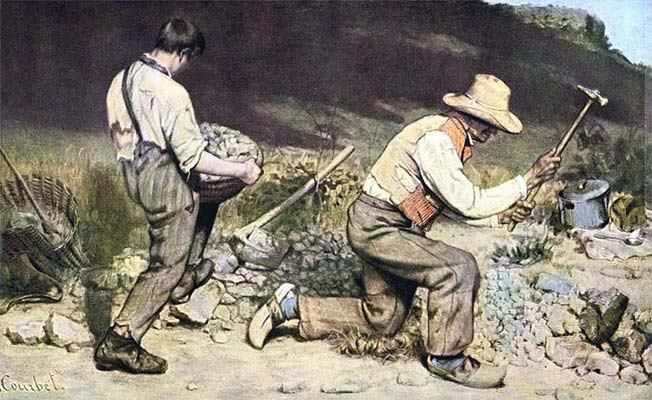
Example of Realism 3
In Byzantine and Medieval art of the Western Middle Ages, much art focused on the expression of subjects about Biblical and religious culture, and used styles that showed the higher glory of a heavenly world, such as the use of gold in the background of paintings, or glass in mosaics or windows, which also presented figures in idealized, patterned (flat) forms. Nevertheless, a classical realist tradition persisted in small Byzantine works, and realism steadily grew in the art of Catholic Europe.
Renaissance art had a greatly increased emphasis on the realistic depiction of the material world, and the place of humans in it, reflected in the corporeality of the human body, and development of a systematic method of graphical perspective to depict recession in a three-dimensional picture space.

Example of Realism 4
The creative arts are often divided into more specific categories, typically along perceptually distinguishable categories such as media, genre, styles, and form. Art form refers to the elements of art that are independent of its interpretation or significance. It covers the methods adopted by the artist and the physical composition of the artwork, primarily non-semantic aspects of the work (i.e., figurae), such as color, contour, dimension, medium, melody, space, texture, and value. Form may also include visual design principles, such as arrangement, balance, contrast, emphasis, harmony, proportion, proximity, and rhythm.
In general there are three schools of philosophy regarding art, focusing respectively on form, content, and context. Extreme Formalism is the view that all aesthetic properties of art are formal (that is, part of the art form). Philosophers almost universally reject this view and hold that the properties and aesthetics of art extend beyond materials, techniques, and form. Unfortunately, there is little consensus on terminology for these informal properties. Some authors refer to subject matter and content - i.e., denotations and connotations - while others prefer terms like meaning and significance.
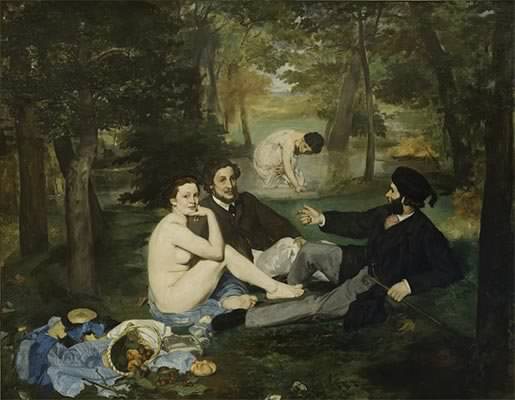
Example of Realism 5
Extreme Intentionalism holds that authorial intent plays a decisive role in the meaning of a work of art, conveying the content or essential main idea, while all other interpretations can be discarded. It defines the subject as the persons or idea represented, and the content as the artist's experience of that subject. For example, the composition of Napoleon I on his Imperial Throne is partly borrowed from the Statue of Zeus at Olympia. As evidenced by the title, the subject is Napoleon, and the content is Ingres's representation of Napoleon as "Emperor-God beyond time and space". Similarly to extreme formalism, philosophers typically reject extreme intentionalism, because art may have multiple ambiguous meanings and authorial intent may be unknowable and thus irrelevant. Its restrictive interpretation is "socially unhealthy, philosophically unreal, and politically unwise".
Finally, the developing theory of post-structuralism studies art's significance in a cultural context, such as the ideas, emotions, and reactions prompted by a work. The cultural context often reduces to the artist's techniques and intentions, in which case analysis proceeds along lines similar to formalism and intentionalism. However, in other cases historical and material conditions may predominate, such as religious and philosophical convictions, sociopolitical and economic structures, or even climate and geography. Art criticism continues to grow and develop alongside art.