Photorealism
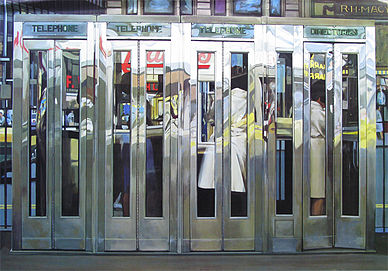
Photo Paint by Richard Estes. Looked like real picture at a first glance.
Photorealism is a genre of art that encompasses painting, drawing and other graphic media, in which an artist studies a photograph and then attempts to reproduce the image as realistically as possible in another medium. Although the term can be used broadly to describe artworks in many different media, it is also used to refer specifically to a group of paintings and painters of the American art movement that began in the late 1960s and early 1970s.
Robert Bechtle's "Automobilia"
As a full-fledged art movement, Photorealism evolved from Pop Art and as a counter to Abstract Expressionism as well as Minimalist art movements in the late 1960s and early 1970s in the United States. Photorealists use a photograph or several photographs to gather the information to create their paintings and it can be argued that the use of a camera and photographs is an acceptance of Modernism. However, the admittance to the use of photographs in Photorealism was met with intense criticism when the movement began to gain momentum in the late 1960s, despite the fact that visual devices had been used since the fifteenth century to aid artists with their work.
One of the most famous photo paint: "Diner" by Ralph Goings
The invention of photography in the nineteenth century had three effects on art: portrait and scenic artists were deemed inferior to the photograph and many turned to photography as careers; within nineteenth- and twentieth-century art movements it is well documented that artists used the photograph as source material and as an aid—however, they went to great lengths to deny the fact fearing that their work would be misunderstood as imitations; and through the photograph's invention artists were open to a great deal of new experimentation. Thus, the culmination of the invention of the photograph was a break in art's history towards the challenge facing the artist—since the earliest known cave drawings—trying to replicate the scenes they viewed.
"Double Ketchup" by Ralph Goings
By the time the Photorealists began producing their bodies of work the photograph had become the leading means of reproducing reality and abstraction was the focus of the art world. Realism continued as an ongoing art movement, even experiencing a reemergence in the 1930s, but by the 1950s modernist critics and Abstract Expressionism had minimalized realism as a serious art undertaking. Though Photorealists share some aspects of American realists, such as Edward Hopper, they tried to set themselves as much apart from traditional realists as they did Abstract Expressionists. Photorealists were much more influenced by the work of Pop artists and were reacting against Abstract Expressionism.
"Double Ketchup" by Ralph Goings
Louis K. Meisel, two years later, developed a five-point definition at the request of Stuart M. Speiser, who had commissioned a large collection of works by the Photorealists, which later developed into a traveling show known as 'Photo-Realism 1973: The Stuart M. Speiser Collection', which was donated to the Smithsonian in 1978 and is shown in several of its museums as well as traveling under the auspices of SITE. The definition for the ORIGINATORS was as follows:
- The Photo-Realist uses the camera and photograph to gather information.
- The Photo-Realist must have the technical ability to make the finished work appear photographic.
- The artist must have exhibited work as a Photo-Realist by 1972 to be considered one of the central Photo-Realists.
- The artist must have devoted at least five years to the development and exhibition of Photo-Realist work.
The Photo-Realist uses a mechanical or semimechanical means to transfer the information to the canvas.