Impressionism
Radicals in their time, early Impressionists violated the rules of academic painting. They constructed their pictures from freely brushed colours that took precedence over lines and contours, following the example of painters such as Eugène Delacroix and J. M. W. Turner. They also painted realistic scenes of modern life, and often painted outdoors. Previously, still lifes and portraits as well as landscapes were usually painted in a studio. The Impressionists found that they could capture the momentary and transient effects of sunlight by painting en plein air. They portrayed overall visual effects instead of details, and used short "broken" brush strokes of mixed and pure unmixed colour—not blended smoothly or shaded, as was customary—to achieve an effect of intense colour vibration.
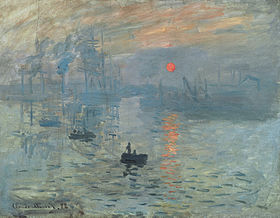
This is a painting of impressionism: "Sunrise" by Claude Monet
Impressionism emerged in France at the same time that a number of other painters, including the Italian artists known as the Macchiaioli, and Winslow Homer in the United States, were also exploring plein-air painting. The Impressionists, however, developed new techniques specific to the style. Encompassing what its adherents argued was a different way of seeing, it is an art of immediacy and movement, of candid poses and compositions, of the play of light expressed in a bright and varied use of colour. The public, at first hostile, gradually came to believe that the Impressionists had captured a fresh and original vision, even if the art critics and art establishment disapproved of the new style. By recreating the sensation in the eye that views the subject, rather than delineating the details of the subject, and by creating a welter of techniques and forms, Impressionism is a precursor of various painting styles, including Neo-Impressionism, Post-Impressionism, Fauvism, and Cubism.
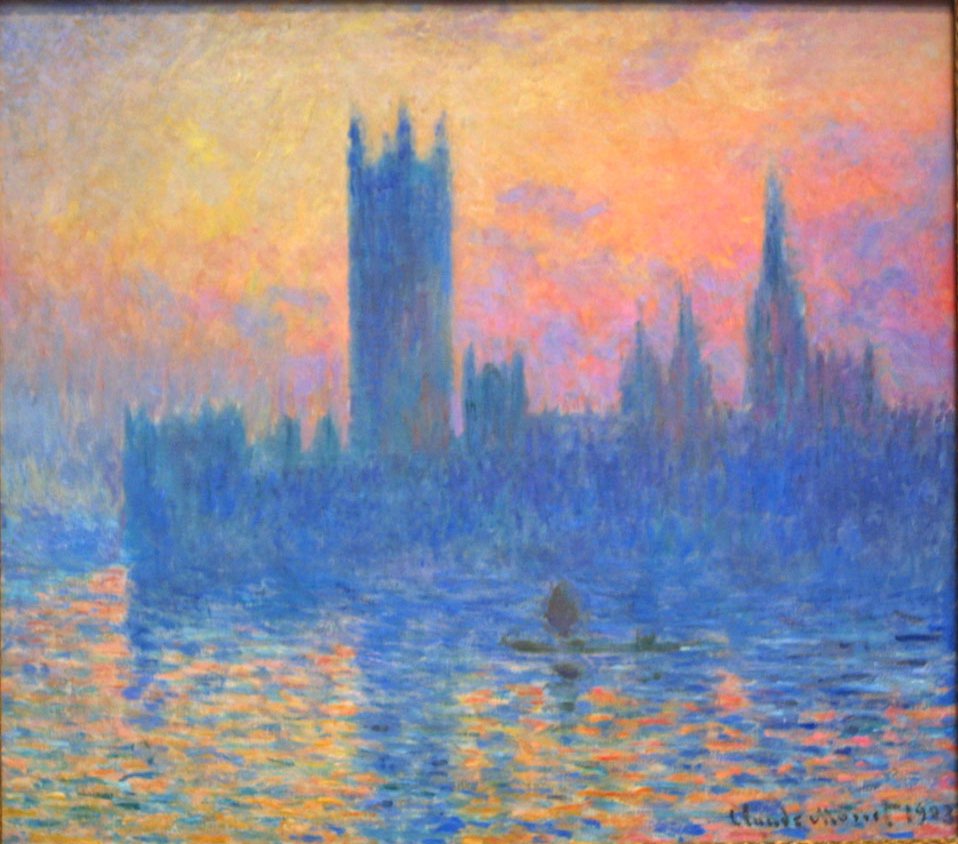
Claude Monet's "The Houses of Parliament"
Both geometric abstraction and lyrical abstraction are often totally abstract. Among the very numerous art movements that embody partial abstraction would be for instance fauvism in which color is conspicuously and deliberately altered vis-a-vis reality, and cubism, which blatantly alters the forms of the real life entities depicted.
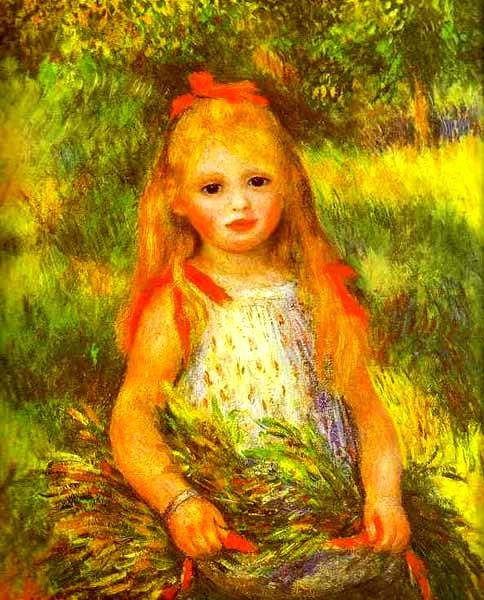
Claude Monet's "The Houses of Parliament"
In the middle of the 19th century—a time of change, as Emperor Napoleon III rebuilt Paris and waged war—the Académie des Beaux-Arts dominated French art. The Académie was the preserver of traditional French painting standards of content and style. Historical subjects, religious themes, and portraits were valued; landscape and still life were not. The Académie preferred carefully finished images that looked realistic when examined closely. Paintings in this style were made up of precise brush strokes carefully blended to hide the artist's hand in the work. Colour was restrained and often toned down further by the application of a golden varnish.